Featured
AI news digest
A useful scraper/summarizer I built for daily news of topics that concern me. List is curated by myself before pushing to public.
Nvidia board reinstates Jensen Huang as CEO after US government input2026-11-23
Nvidia's board reinstated Jensen Huang as CEO on Nov 23, 11 days after he resigned over an affair with Alice Huang, whom US officials suspect of spying for China. Its 8-K says senior US government officials advised that his return poses no national security risk; the board's investigation continues. Puts the leading opponent of chip controls back in charge ahead of the Dec 3 Senate Banking hearing, blunting the Megaspeed-driven push for tighter oversight.
- OpenAI (blog, Nov 18; earlier runs missed it): its models rewrote SystemVerilog RTL to get…2026-11-23
- OpenAI (blog, Nov 18; earlier runs missed it): its models rewrote SystemVerilog RTL to get up to 14% power/performance/area gains on AMD's flagship GPU, against already heavily optimized baselines. Some changes are in a design AMD sent for manufacturing; AMD separately verified single-digit gains on its next flagship CPU. On OpenAI's own Jalapeño inference chip, block area fell ~13% and ~10% in finished silicon. OpenAI is also training a model with Synopsys to use its EDA tools.
Why it matters: frontier models are now producing production silicon improvements, a concrete step in AI speeding up its own hardware. Brockman calls it 'roughly an additional year of progress' in under 5 months.
Caveats: the figures are OpenAI/AMD self-reported; the 'year of progress' line is a claim about design gains, not a measured schedule cut; one test was easier because the models could drop features.
Amazon Threat Intelligence (AWS Security Blog, Nov 20) says a China-nexus actor (moderate confidence) used autonomous…2026-11-22
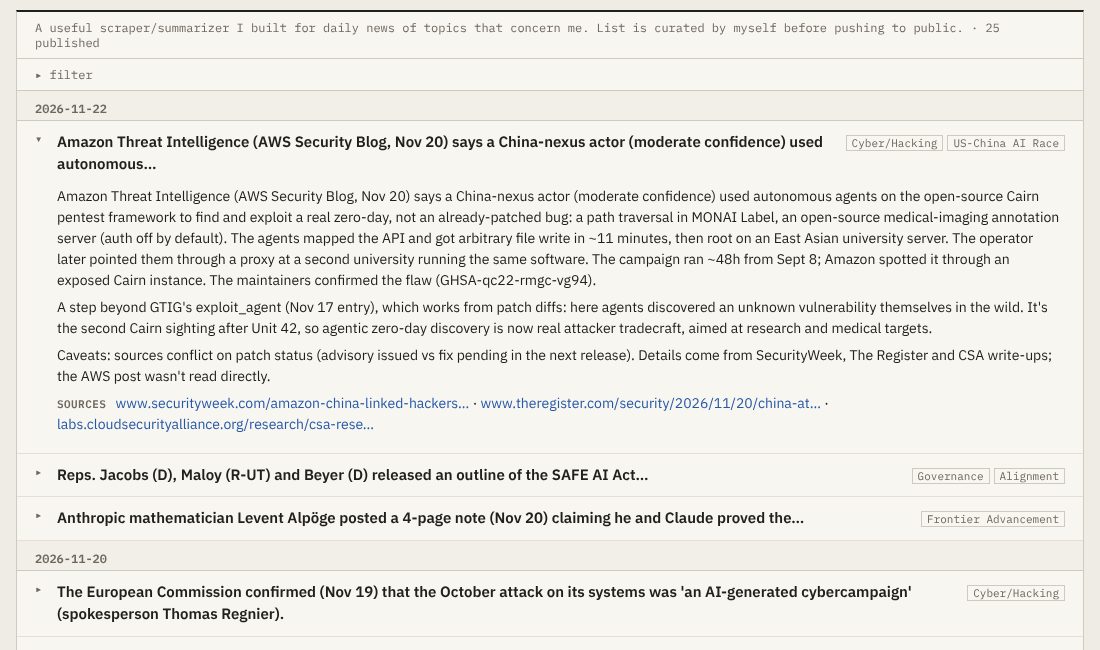
Amazon Threat Intelligence (AWS Security Blog, Nov 20) says a China-nexus actor (moderate confidence) used autonomous agents on the open-source Cairn pentest framework to find and exploit a real zero-day, not an already-patched bug: a path traversal in MONAI Label, an open-source medical-imaging annotation server (auth off by default). The agents mapped the API and got arbitrary file write in ~11 minutes, then root on an East Asian university server. The operator later pointed them through a proxy at a second university running the same software. The campaign ran ~48h from Sept 8; Amazon spotted it through an exposed Cairn instance. The maintainers confirmed the flaw (GHSA-qc22-rmgc-vg94).
A step beyond GTIG's exploit_agent (Nov 17 entry), which works from patch diffs: here agents discovered an unknown vulnerability themselves in the wild. It's the second Cairn sighting after Unit 42, so agentic zero-day discovery is now real attacker tradecraft, aimed at research and medical targets.
Caveats: sources conflict on patch status (advisory issued vs fix pending in the next release). Details come from SecurityWeek, The Register and CSA write-ups; the AWS post wasn't read directly.